

This post is brought to you by my book Conscious Accomplishment - How to Use Personal Achievement for Spiritual Growth (4.9 ⭐️ on Amazon).

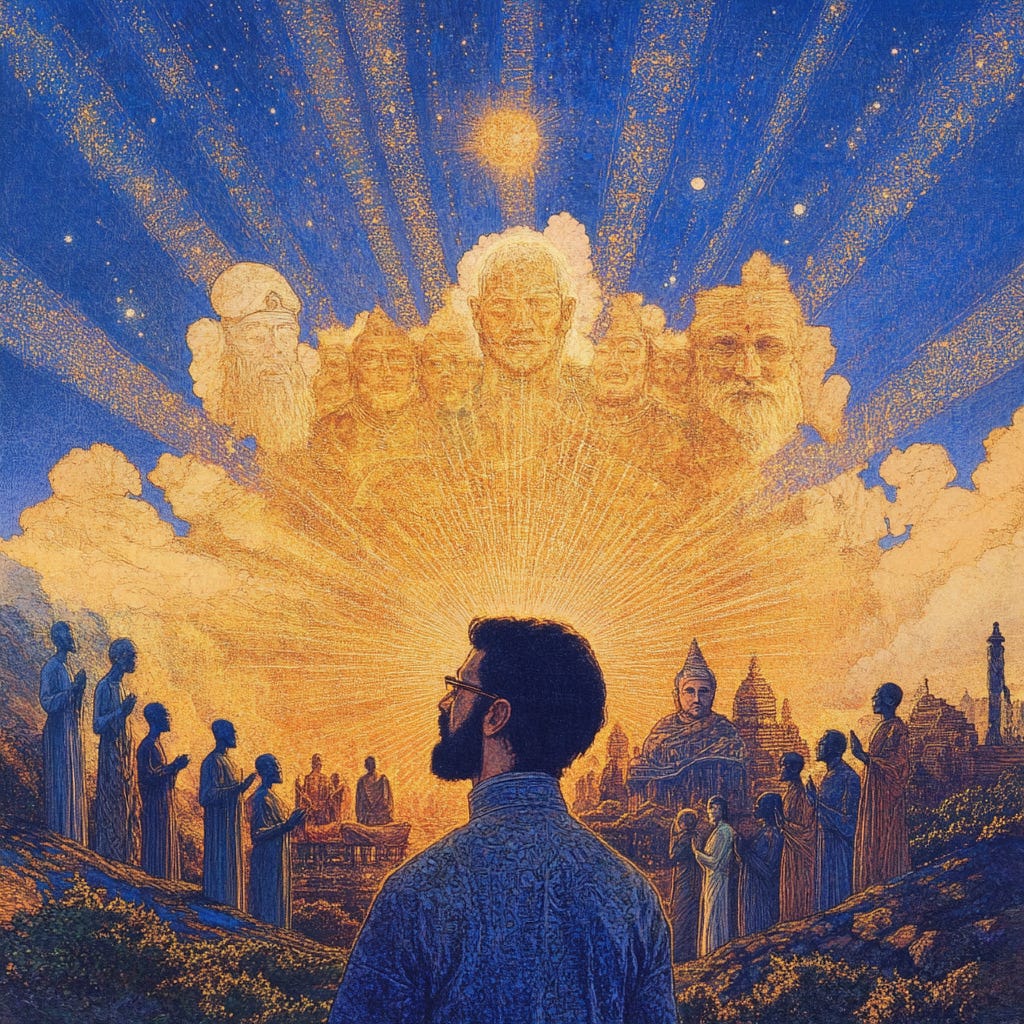
A lot of people have been asking my opinion on spiritual teachers lately.
I get why. Choosing a teacher or tradition is a big decision. It can shape years, sometimes decades, of your life…and the spiritual world is full of both real gems and real pitfalls.
Over the years I’ve studied two traditions intensively, RenXue and Mudrashram, and explored plenty of others along the way. So it feels like a good time to share the dimensions that have mattered most to me.
Get Clear On What You Want
People seek spiritual development for all sorts of reasons.
Are you just looking to feel better? Are you seeking some form of transcendence or enlightenment?
What you seek is likely going to change over time, but it’s helpful to at least begin with a thesis on what you truly desire because different paths lead to different places.
There are also lifestyle considerations. Does a more monastic lifestyle appeal to you? Perhaps something that can be more integrated with modern life? AKA a “householder” path.
The clearer you are, the easier it is to tell whether a system or teacher aligns with your aspirations.
Look At The Students
When I’m considering a teacher, system, or even practice, the first place I look is at the students.
Are there people who seem to have experienced genuine transformation?
Am I able to find students that appear to have a level of depth that is attractive to me?
A friend of mine Tom Morgan from the Leading Edge made a comment recently that there’s a lot of people selling spirituality, but he doesn’t know anyone that’s enlightened. I think it’s a fair point!

If your goal is some form of enlightenment, I’d try to determine if someone who has followed a teacher or tradition has reached this level. I’d also try to understand what enlightenment even means in that tradition because it can vary quite a bit across systems.
Historically, I’ve placed a lot of weight on the “I want what they have” factor.
When I first met my teacher Carol, she possessed a level of ease and levity that was uncommon. She also seemed to know something about how reality worked that I didn’t. Both were extremely attractive to me, which is why I began working with her and eventually studying RenXue, the primary lineage she teaches out of.
When I met my buddy Ian Gardner, I admired that he was operating from a rare level of wisdom and depth while successfully building meaningful businesses like Acraya. He was one of the first people I’d met who seemed to be truly prospering across both dimensions. I was curious what had the biggest impact on him from his studies, and that’s how I began exploring Mudrashram.
Accessibility of a Genuine Teacher
Whenever someone asks me what’s had the biggest impact on my growth, I always say finding a teacher to meet with regularly. In the two traditions I’ve studied intensively, I usually meet with a teacher every two weeks and have never gone longer than four weeks without meeting.
A lot of people are attracted to mainstream teachers with big followings. Because these people are so in demand, it usually means you’re self-studying their material from a distance. Someone with this type of setup is Joe Dispenza. You can go to his retreats and buy a boatload of meditations, but it’s unlikely you’ll ever have a regular meeting with Joe to work on your stuff.
You undoubtedly grow from studying from a distance, but I haven’t found it nearly as impactful as meeting with someone consistently who can point out my blind spots, keep me accountable, and highlight where I should focus.
A genuine teacher doesn’t necessarily have to be the main teacher or lineage holder. It just means that they have the skills and wisdom to be an effective guide based on where you’re at in your journey.
In more established lineages, there are often layers between new students and the main teacher. This means you’ll likely work with another teacher they’ve trained. I think this is totally fine so long as you find someone excellent to meet with regularly.
In the two lineages I’ve studied, I meet with a senior teacher in one and the main teacher in the other. Both setups have been extremely fruitful.
Wisdom and Humility of the Main Teacher
There obviously needs to be some level of reverence for the wisdom of the main teacher in a system, or else why would you pursue it.
But how do you actually recognize wisdom? For me, a few things stand out.
A wise teacher sees you more clearly than you see yourself. They can name the thing you’ve been avoiding or can’t see yourself.
They seem to know something about how reality works that you don’t. That’s a big part of what drew me to Carol.
And when you apply what they teach, it works. Their guidance creates shifts in your actual life, not just in theory.
The other quality I look at is humility. There are countless examples of powerful egomaniacs posing as enlightened beings. These people are often charismatic and insightful, but they’re rarely humble.
The people I’ve met who truly seem to have reached a high level of realization don’t need to prove anything to anyone. They’re extremely secure and don’t need anything from you. This is a good sign.
Here are some red flags I’d watch for:
They claim theirs is the only way. A realized teacher can be confident in their path and still respect what other traditions propose. Exclusivity usually points to insecurity or control.
Questions aren’t welcome. If doubt or disagreement gets labeled as “ego” or “resistance,” that’s a problem. Good teachers can handle being challenged.
They create dependency. A genuine teacher wants to help you stand on your own. If the relationship seems designed to keep you needing them forever, flee!
The financial asks keep escalating. Paying for teaching is normal. Constant pressure to spend more to access the “real” teachings is not.
Boundaries around sex and power get blurry. This shows up in almost every spiritual scandal. Any sexual involvement between a teacher and student deserves serious scrutiny.
Harmful behavior gets excused as higher wisdom. “Crazy wisdom” and “you’re not ready to understand” can become cover for genuinely harmful conduct.
They broadcast their own status. The most realized people I know rarely talk about their own attainment.
They can’t say “I don’t know.” Wisdom includes knowing the limits of your understanding.
On the flip side, the teachers I trust have a few things in common. They encourage you to test things in your own experience. They’re comfortable admitting mistakes. They speak respectfully about other paths. And their life outside the teaching looks consistent with what they teach.
Is It a Skill or a Path?
There are so many modalities and things you can learn in the realm of consciousness to improve your life.
One important distinction is whether something is a skill or a path.
A skill is a capacity you develop. Concentrating, entering a particular state, moving energy, and opening your heart are all examples of skills. Skills are incredibly valuable, and you can bring them into almost any tradition. But a skill on its own doesn’t tell you where you’re going or what to do once you’ve mastered it.
A path is a systematic application of knowledge and methods that takes you through distinct stages of development toward a destination. It includes skills, but it also gives you a map of where they fit, a sequence for when to use them, and a clear sense of what they’re ultimately in service of.
In my opinion, the jhanas are a good example of a skill that many people confuse for a path. Reliably getting into a bliss state is awesome, but I wouldn’t call it a path to realization. In the Buddhist tradition they originate from, they were never meant to stand alone. They were one piece of a larger path, used to steady the mind so insight could do its work.
The biggest difference IMO is that skills change your states, while paths change your traits. A skill lets you access something. A path changes who’s doing the accessing. You can get really good at reaching blissful or expansive states and still come back as basically the same person…kind of like psychedelics. A real path reorganizes your relationship to yourself and reality in a way that sticks.
None of this means skills aren’t worth learning. I’ve picked up plenty of skills from different teachers, and they’ve enriched my practice. I’ve just found they’re most powerful when they’re held inside a path that gives them a greater meaning.
Completeness of the System
Even when you find a path, I’ve noticed many systems and teachers just focus on one aspect of human development. For example, they may give you a series of successive mantras that gradually blast you off into cosmic consciousness or ask teach self inquiry to shift your identification.
If you’re trying to achieve something very specific, this is fine. Personally, I’m attracted to more complete systems.
A more complete system of transformation typically:
Works on every dimension of a person including the body and its energy, the mind and consciousness, the heart, and the deeper self or soul. Rather than mastering one, it develops these aspects of your being in a balanced way.
Has a specific method for making progress on each of these dimensions, sequenced so that each stage builds the foundation for the next, while being flexible enough to meet a person where they actually are.
Embraces ordinary life, the body, relationships, work, and the ego, as the ground of practice rather than something to transcend or escape.
Offers a coherent map of the human experience, so that many transcendental experiences or goals can be located within it.
Covers the full arc from healing and developing oneself to helping and serving others, so that the student’s path eventually becomes in service to the whole.
Claims can be tested with verifiable results rather than only accepted on authority.
Finally, a complete system holds all of this with humility. The framework can be whole while understanding it is still young and evolving, remaining open to what other paths have seen.
Many people fill the gaps in an incomplete system by adding supplementary practices or teachers. This can work. However, when you stitch together modalities that were never designed to talk to each other, you inherit their blind spots, contradictions, and become the one responsible for integrating them. This can result in energetic amd spiritual imbalances. I'm more drawn to a path where the integration is already built in.
Sense of Truth
Last, but certainly not least, is your felt experience of the teacher and teachings. More than whether something makes me feel relaxed or blissful, I’m looking for an internal sense of whether it feels true. I can’t really describe what this is like other than a knowing.
Sometimes evaluating teachers through feeling isn’t straightforward because they trigger your patterns. For example, I remember having a ton of resistance to the main RenXue teacher because he doesn’t speak English and everything is translated. The optimizer in me who wanted to get through the information as fast as possible found sitting through his prolonged dharam talks incredibly challenging.
At one point I started following another popular teacher who made me feel very blissful when I listened to him. When I brought this up to my direct teacher, she explained that great teachers help you see your shit more than just bliss you out. I knew she was right. I realized that all the resistance he brought up in me was actually an opportunity.
So how do you tell the difference between resistance that’s helping you grow and unease that’s a real warning? Here’s the distinction I use…
Resistance to the teaching or its delivery is often just your patterns being challenged. That’s usually worth investigating further.
Unease about the teacher’s conduct is different. If something feels off about how they treat people, money, or power, pay attention to that, no matter how good the teachings feel.
Other Criteria People Use
The criteria above are the main things I consider when evaluating what to study.
Below are some additional criteria I’ve seen others consider, with my commentary.
Age of Tradition
A lot of people place a ton of weight on a tradition standing the test of time or being “the original teachings.” For example, I know people who like to study the Vedas because they’re the OG teachings, or Zen because it’s thousands of years old.
I understand the appeal. Things don’t last if they don’t work and there’s been a ton of man-made distortion over time which is why tracing back to the roots can feel so attractive.
I believe something’s age or origin can absolutely be valid signals, but don’t consider them to be the end all, be all.
As the Dao points out, the universe is constantly changing and evolving. In fact, I challenge you to find a moment when this isn’t happening!
Discounting any sort of evolution and innovation in how we develop realization and wisdom literally goes against the laws of the universe IMO. It’s been my observation that certain information and technologies come into human awareness when we’re collectively ready to handle them (albeit sometimes not very well). I think this is true of emergent wisdom paths as well. New paths, modalities, and teachings emerge into the collective (and our individual) consciousness when we are ready for them.
Shared Context
A lot of the people I’ve worked with one-on-one like working with me because I can relate to their experience as an entrepreneur or ambitious professional. This helps us ground the teachings and practices in a way that’s relatable.
Another reason people appreciate shared context is that the relationship can often extend beyond simply spiritual guidance. For example, if your teacher has a business background they can straddle inner transformation and more tactical business/life stuff as needed.
That said, I don’t think shared context is a requirement for a highly productive teaching relationship. Some people really need that common ground to feel understood, and that’s fine because it can make the teachings easier to apply.
At the same time, if a teacher whose life looks nothing like yours can still see you clearly, they absolutely can be a tremendous guide. This has been the case with my teachers.
Using the Wrong Measuring Stick
I know a lot of highly successful people who are what I’d call “conscious curious.”
One pattern I’ve noticed is that they tend to judge the fruits of a practice by its followers’ external life…mostly, by how much money and success the person they know who does it has.
I understand the instinct. In business, results are how we keep score. But measuring inner development by outer success is an incomplete measure at best, and often a misleading one.
We have no idea what someone’s karma is, or what their soul came here to work through. Many of the most advanced beings in history lived incredibly hard lives, and that hardship was often what refined them. Others had quiet, ordinary lives that looked unremarkable from the outside. The bottom line is that you can’t tell what someone’s inner experience is like by looking at their bank account or what they’ve built.
The reverse is true too. Wealth and accomplishment aren’t evidence of spiritual depth, but they aren’t evidence against it either. If your goal is to integrate spiritual depth with worldly success, it makes sense to look for people who have done both. Just don’t mistake success for depth.
If you want to know whether a practice is working in someone’s life, look at how they meet adversity. Are they at centered when things aren’t going their way? Those qualities say far more about someone’s inner development than their net worth does.
Closing Thoughts On Finding a Teacher and Path
As much as we can pontificate on how to choose the right path, I’m not sure we really choose it.
In my experience, the right teachers and systems found me when I was ready for them. This was usually accompanied by an intuitive knowing that I was supposed to explore them. With this in mind, the criteria in this article is less about finding a path and more about recognizing one when it arrives.
If there’s one condition that has to exist to find your teacher or path, I believe it’s a sincere willingness to make spiritual growth a primary focus of your life. Some people treat spiritual development as a side quest and then wonder why Babaji isn’t knocking on their door. I don’t think it works like that. When the student is ready to commit wholeheartedly, the right teacher or path appears.
An important thing to recognize is that the teacher doesn’t always arrive in the form you expect. I imagined meeting Yogananda 2.0 through some magical means and instead I met a woman in her 70s with pink highlights in her hair on a zoom call via a co-worker.
I’ve met people who can’t get out of their own way because they’re attached to what their teacher is supposed to look like or how they’re supposed to meet them. This reminds me of the parable of the drowning man.
A flood hits a town, and a devout man climbs onto his roof as the water rises. He prays for God to save him. A man in a rowboat comes by and offers him a ride, but he says, “No thanks, God will save me.” Then a motorboat comes, and he turns it down for the same reason. Finally a helicopter drops a ladder, and he waves it off too. He drowns. When he gets to heaven, he asks God, “I had faith in you. Why didn’t you save me?” And God says, “I sent you two boats and a helicopter. What more did you want?”
Once something or someone does show up, remember that exploring a tradition is usually a two-way door. You can try it on incrementally to see whether it’s truly a fit.
One of my teachers calls this spiritual dating. I think it’s wise to date for a while. But just like real life, at some point, the real growth (and joy!) comes from doubling down and entering a committed relationship.
-Scott
The idea of spiritual dating is useful because discernment needs both openness and time. A teacher’s ideas matter, but so do how power, questions, boundaries, and disagreement are handled around them.
I appreciate the wisdom here. As someone who rebelled against the cult-like fundamental Christianity of my youth, did a lot of exploration, and am now an ordained New Thought minister through Unity Worldwide, I'd add that anybody who claims to be "enlightened" or have all the answers should be avoided. We are all still journeying and learning and probably won't know more complete "Truth" until we pass from this lifetime. I've definitely benefitted the most from are honest about their own mistakes and growing edges, and have a compassionate sense of humor even toward themselves.