

The ideas below are simply a reflection of my direct experience applying the wisdom of many great teachers to my life. They are not my prescriptions on how others should live their life. I share these thoughts and experiences not to gloat or cast judgment, but rather to feel the joy of creatively expressing myself and to potentially help others on a similar journey.
**after getting a lot of feedback on this post, I decided to go a bit deeper with this video series on Surrender. Check it out!**
“He consciously moves with the cosmic current. In moving he loses nothing but his limitations. He can take with him in essence all the experiences and understanding that he has gained.”—Collins
One of the most impactful, yet challenging concepts on the spiritual path is surrender. Similar or equivalent concepts might be called acceptance or detachment depending upon the tradition, but the broad idea is pervasive across most major religions and many ancient teachings.
One simple way to think about surrender is unconditional acceptance of what happens as the world unfolds around you.
The first time I encountered this idea with an open mind, I remember thinking “wow, that sounds great!” You mean all I have to do is just let everything happen and life will be great. Sign me up!
The truth is that actually pulling this into practice within the demands of western society can be very difficult and confusing. I’ve found there to be immense nuance that can make you feel like you’re chasing your tail or even compel you to give up without proper understanding.
The intent of this article is to share what has been helpful in my own direct experience, not to tell you what is right for you.
The Concept of Surrender
The model of self realization pictured below very much mirrors my own experience of the stages of spiritual progression.
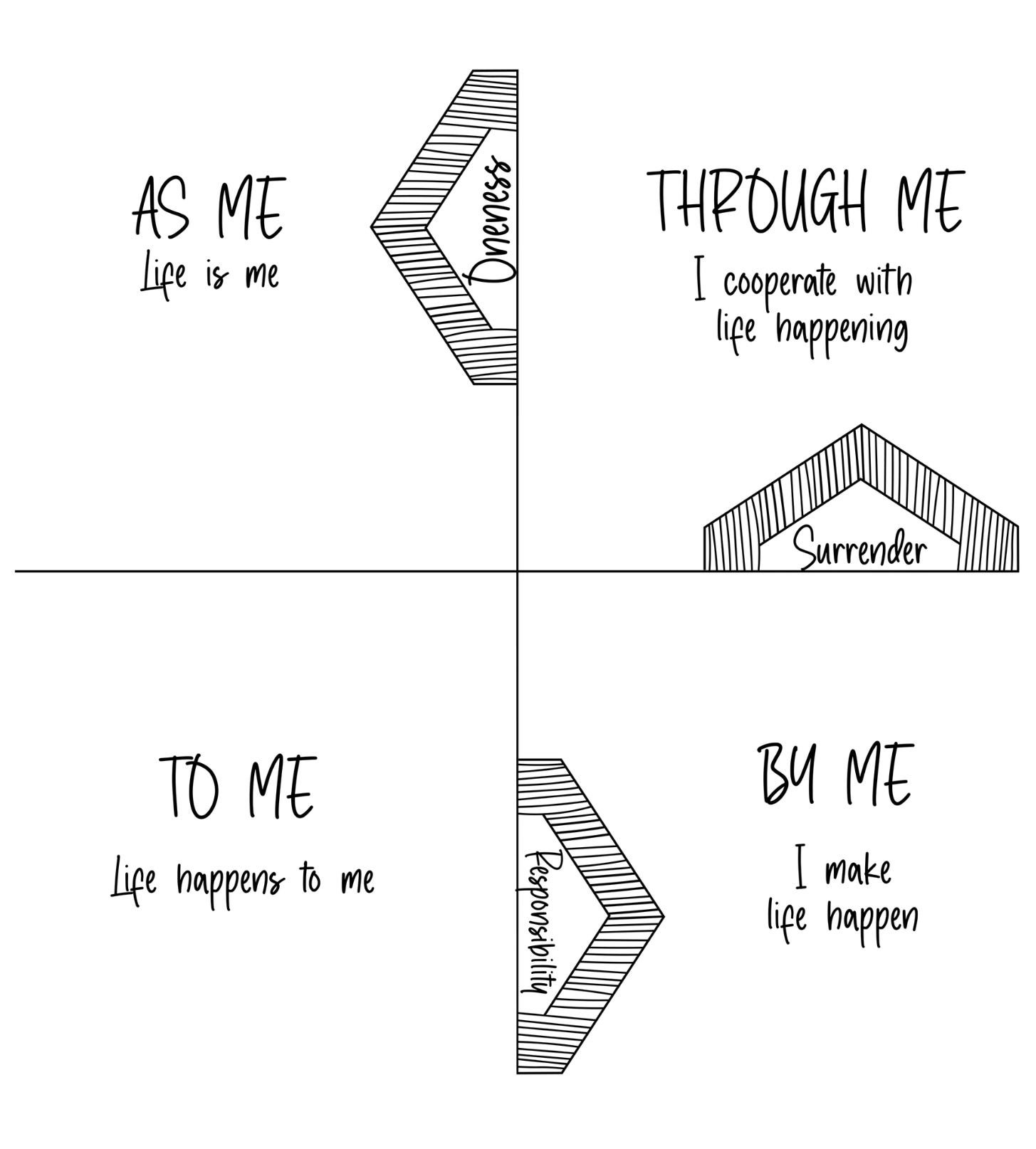
I think I might have first encountered this progression in The 15 Commitments of Conscious Leadership. Moving from the bottom left, the evolution of consciousness can be described as:
Life happens to me (victimhood)
Life happens by me (personal will)
Life happens through me (surrendered, spiritual vessel)
Life happens as me (Self/God realization, oneness)
For the first 30 years of my life, I had been rewarded for control. For getting out what you put in. It’s what we are conditioned to do at a young age and you can’t fault a single person for being this way. In the United States, everywhere we go we are fed this type of rhetoric during our formative years and it is reinforced by the false gods of our society (status, excessive wealth, etc).
As a result, this pattern can be quite hard to break. In the model above, this corresponds with “life happening by me.”
My entire existence was based on achievement with the idea that if I acquired certain things whether it be a financial position in the world, a romantic partner, friend group, status or accolade, I would feel good. This is the dogma that society thrusts upon you, and for a while this way of being can in fact make you feel good! When things are good, you’re good. But eventually, no matter who you are things may take a turn for the worse and you must internally and externally deal with the circumstances.
The strategy most of us employ in the scenarios is to figure out what adjustment we need to make to the outside world in order to return to feeling good, temporarily.
...until one day you recognize this treadmill existence is a fool's errand or an unwinnable game.
I had grown up in a Christian household and heard a lot of sermons through the years around giving it all up to God. For some reason, this just didn’t seem to resonate for me. I was fearful that submitting my sovereignty to some amorphous figure in the clouds relegated me to a life of poverty and boredom. The idea of surrender seemed to be in direct competition with the acquisition of things I wanted which felt dangerous and complacent.
“So am I just supposed to sit there on a mountain top and do nothing!?”
How could you possibly have a good life living like this?
So I did what most people do, which is self rationalize the pursuit of their egoic desires by disguising my ambition in the name of the greater good and mostly save God for later.
I’m going to build a big company, and make a lot of money, and then give back, and doing this is serving god. And because I’m in a position of leadership and I am a good person, this will give me an opportunity to impact others and be a positive influence on society. And then when I’m really, really successful and have done all the things I want to do, I will then focus completely on god-centered, save the world type activities.
This was my narrative.
It’s not that this general trajectory is at odds with serving the greatest good. It’s that for me personally, behind this story was an underlying motive of grasping for self importance and survival vs. true unconditional love and service for others.
One thing I’ve learned about the spiritual path is that motive and intent often carry more weight than the content of the actions themselves in their ability to uplift or undermine your growth. Thus, radical honesty and investigation play a pivotal role in your expansion of consciousness.
It wasn’t until I read Michael Singer’s book “The Surrender Experiment” that I was intrigued by the concept of Surrender.
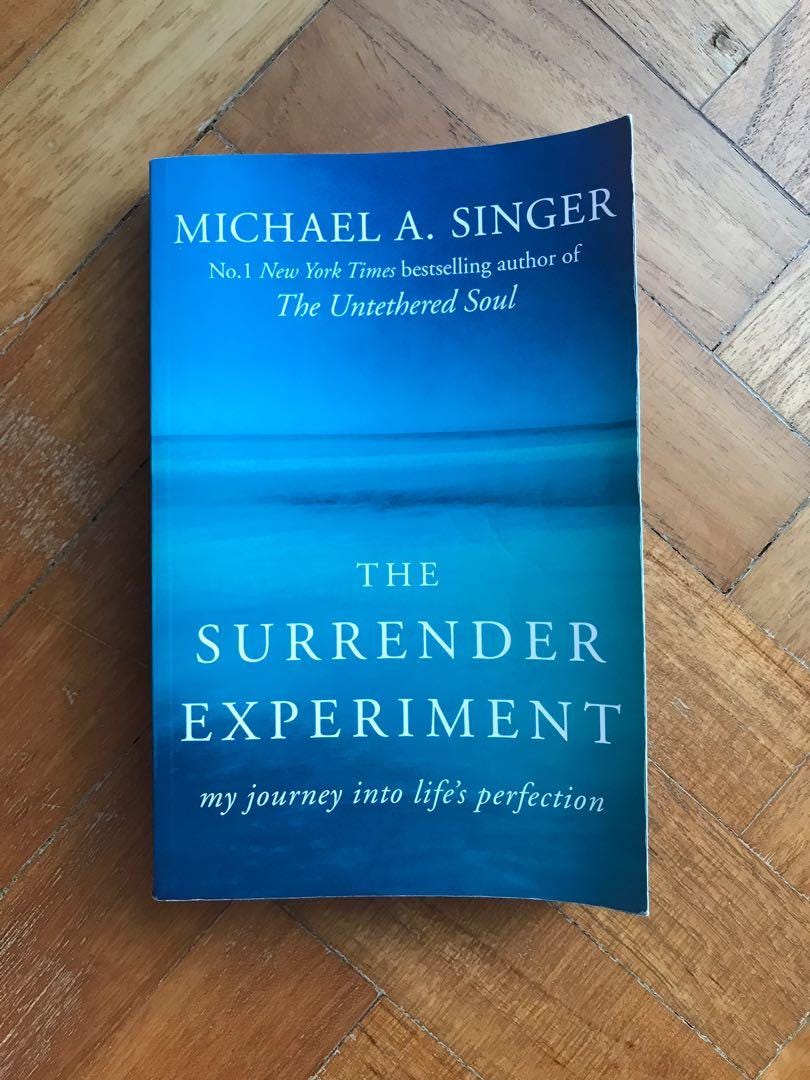
Why did it appeal to me? Because he posited that the process of surrender was in fact the highest leverage way to bring abundance into your life and be happy.
Here he was, someone who tried to drop out of life and ended up becoming the founder and CEO of a billion dollar public company. That appealed to me, and by me, I mean my ego. The ego wants things and paradoxically the early parts of spiritual ascension are fueled by the ego because you think that by growing spiritually it will get you something.
Surrender seemed like a path to achieve spiritual growth without completely giving up the pursuit of things outside myself. In some ways, it kind of felt like making Michael Singer successful in business and then having him write a book about it was the universe’s little way of luring high achieving people like myself into this path.
The concept of the book and idea which spans many religions is to accept life fully as it comes. To stop striving, grasping, and controlling, and be at peace with what life brings to you. There is also a deeper level that deals with actively surrendering the personal will to the divine will.
The risk that many people face is one of conditional surrender. Sure, I'll accept life as it comes, so long as it matches my preferences!
Unfortunately, that is not how this works. And if you get stuck in conditional surrender land, you won’t end up making a ton of progress on the quest for returning to the truth of who you really are.
The highest path of surrender is unconditional. To accept all things with equal reverence. You sell your company, you welcome and accept it. You get sick, you welcome and accept it. The good, the bad, it all must be embraced with open arms.
In practice this was very tricky for me, especially coming from 30 years of conditioning that posited living by the personal will was the way to be happy.
In the beginning, surrendering is very hard. But like any muscle, over time as you increase the good repetitions of surrendering, you will get stronger and this will get easier. As this occurs, you will find yourself evolving from surrendering to an annoying thing here or there, to it becoming what feels like an automatic, habituated process (embodiment).
There are multiple phases of surrender. The first is non-reactivity and acceptance. This looks like just being at peace with what comes your way. The more advanced spiritual path is surrendering your personal will to the will of God. This occurs at a certain level of awareness where you begin to receive direct transmission and guidance that you know is true. This is hard to explain unless you experience it directly, but when this occurs, you start to experience life happening “through you” and eventually as you.
I have gotten a lot of questions about the various phases of Surrender so I created an expanded video series on Surrender as well as explanations of Phase 1, Phase 2, and Phase 3 surrender.
Below are some ideas that once clarified and cemented, helped me immensely in my pursuit of living from a place of surrender.
Surrender Does Not Mean Apathy
To think that working on oneself requires “dropping-out” of society is to miss the point. Certainly you must drop out . . . but the drop-out is internal, not external. - Ram Daas
Oftentimes people misconstrue the idea of surrendering to life as doing nothing. They read a book like the Surrender Experiment and take it so literally that they think they should just do nothing and say yes to everything that comes your way.
This is an incorrect interpretation of surrender. This way of life is more about putting in your earnest effort into the things you are doing and then as life unfolds, being accepting even if things don’t go your way. Surrendering or letting go doesn’t absolve you of the world, it absolves you of your negative reactions to it.
In order to get good at this you must develop the ability to observe your thoughts and reactions so that you can slow down and start to watch life unfold. This is where practices like meditation come in and allow you to move from a place to being the thoughts vs. witnessing or watching them. Some traditions call this witness consciousness. Being seated here allows you to see negative thoughts and reactions in real-time before they become actualized so that you can more selectively choose your behaviors.
Once you’re watching the thoughts and reactions, I’ve found the most constructive way to engage any internal experience or resistance is to just relax into it. This is the path of surrender…and it can be really hard at first!
If you’re on a plane, and a thought pops into your mind of the plane going down, what do you do? Most of us, immediately try to divert our thoughts to something else. We don’t like acknowledging that we even had this thought, let alone sitting with it. It’s uncomfortable and part of us is scared that even by thinking of it, maybe even the odds of it materializing increase.
This resisting, fighting or trying to change things on the inside or outside is what we are taught to do and a natural proclivity of the ego’s survival mechanism.
The alternative path is to practice letting go which I’ve outlined in detail here.
It’s Okay to Have Goals and Enjoy Things
“Taking pleasure in your physical life is as much a spiritual goal as achieving a healthy physical body. Both are the consequences of following Divine guidance in making choices of how to live and of acting out of faith and trust. Surrender to Divine authority means liberation from physical illusions, not from the delights and comfort of physical life.” -Caroline Myss
I remember when I first started to consume a lot of spiritual material related to surrender and detachment I was very confused.
So does this mean you shouldn’t have goals? What about all my preferences that I have developed over the years? Can I be surrendered and like things?
The surrender step on the path to awakening precedes enlightenment (permanent realization of the Self) so it is natural to still identify with the “you” that has preferences or wants things.
At this level of consciousness, it’s unrealistic to expect you shouldn’t want things or have aspirations. So my experience is its best to relinquish self judgment and allow yourself to be okay with having them. The key is as life unfolds learning to be okay with it not going the way you had anticipated. Maybe it happens, maybe it doesn’t. I’m going to be fine either way, and it’s not really a big deal!